Oct 14, 2026
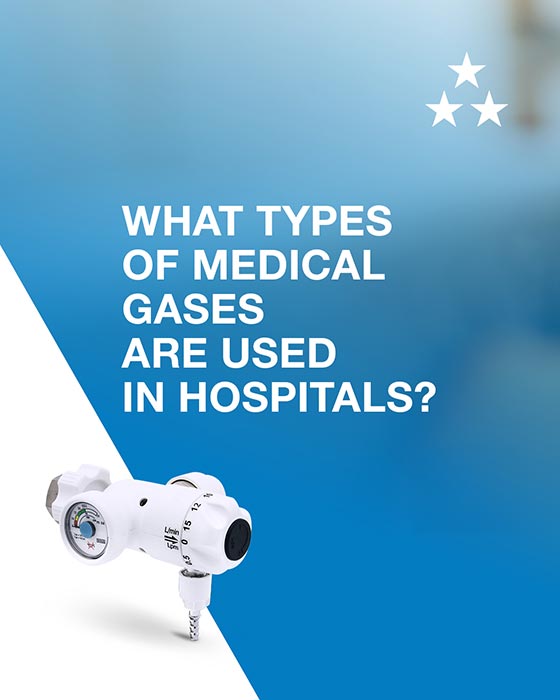
What types of medical gases are used in hospitals and what equipment do they require?
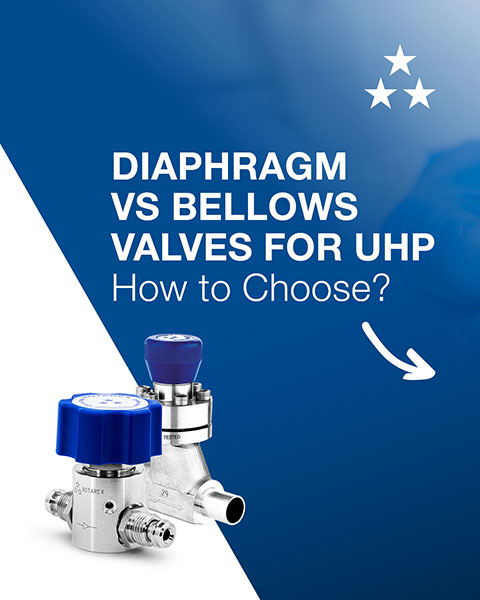
Both isolate the gas stream with a metal seal and no packing, which is what separates them from conventional valves. The right choice between a diaphragm valve and a bellows valve depends on flow, pressure, temperature, chemical compatibility, and where the valve sits in the gas system.
Diaphragm and bellows valves are both designed to provide high leak tightness and to isolate the process fluid from the valve stem and atmosphere. However, their main difference lies in their operating range and where they are typically used within a gas system.
Bellows valves are typically used at the beginning of a gas line, close to the source. For example, they may be installed directly downstream of a liquid helium tank or another high-pressure gas source.
In this position, the valve must withstand a relatively high inlet pressure and, in cryogenic applications, very low temperatures. Bellows valves are particularly well suited to these demanding conditions.
Diaphragm valves are more commonly used further downstream in the gas distribution system, particularly near the equipment or point of use.
At this stage of the system, the gas pressure has generally already been reduced by regulators or other pressure-control components. The inlet pressure seen by the diaphragm valve is therefore typically lower than that encountered by an upstream bellows valve.
| Criterion | Diaphragm valve | Bellows valve |
|---|---|---|
| Sealing mechanism | Flexible metal diaphragm on a soft seat | Welded metal bellows around the rising stem |
| Flow capacity (Cv) | Low to moderate (Rotarex up to about 3.5) | High (Rotarex up to 114) |
| Pressure range | Up to 240 bar | Up to 300 bar, 400 bar in nuclear service |
| Temperature range | -40°C to +150°C (seat dependent) | -270°C to +250°C |
| Internal (dead) volume | Very low, compact | Higher, longer stroke |
| Throttling | Limited, weir body | On and off isolation, limited throttling |
| Typical position | Point of use, gas box, panel | Bulk supply, distribution, cryogenic lines |
| Best for | Cleanliness at the tool | High flow, high pressure, extreme conditions |
Diaphragm valves provide excellent isolation between the process gas and the valve stem or actuator. The diaphragm forms a static barrier between the gas-wetted flow path and the operating mechanism, eliminating the need for dynamic stem packing. This helps minimize external leakage and prevents contaminants from entering the gas stream. Rotarex UHP diaphragm valves achieve helium leak rates down to ≤ 1 × 10⁻⁹ mbar·L/s and are 100% helium leak tested.
Because the diaphragm keeps every moving part out of the flow path, there is no metal to metal rubbing where the gas travels.This is particularly important in semiconductor and other ultra-high-purity gas systems, where particles and contaminants can affect process quality and manufacturing yield.
The gas-contacting parts can be selected to suit the process gas and operating conditions. Industrial diaphragm valves typically use PTFE or EPDM diaphragms to provide chemical resistance and reliable isolation for a wide range of gas applications. For ultra-high-purity (UHP) gas systems, diaphragm valves typically use a metal diaphragm combined with an electropolished 316L stainless steel body to minimize contamination and provide excellent corrosion resistance. The valve design keeps the process gas contained within a clean, sealed flow path, helping maintain gas purity and prevent external contamination.
The flexible diaphragm is built for a long cycle life under repeated actuation. The diaphragm is the main wear part, and diaphragm replacement is a simple service with no packing to adjust. Manual and pneumatic actuation, including oleo-pneumatic, is available for automated tool integration.
The main advantage of a bellows valve is its exceptionally high external leak tightness. A welded metal bellows forms a sealed barrier around the moving stem, eliminating the dynamic stem seal as a potential leakage path. This makes bellows valves particularly suitable for toxic, corrosive, radioactive, ultra-high-purity, and other hazardous gases where even very small external leaks can create safety or contamination risks. Rotarex bellows valves are 100% helium leak tested, with selected models achieving certified external helium leak rates as low as ≤ 1 × 10⁻¹⁰ Pa·m³/s.
Metal bellows tolerate a wide temperature range. Rotarex cryogenic bellows valves operate from -196°C, and the SUPRA series down to -270°C for liquid helium. At the other end, metal bellows suit high temperature service such as pressure steam and thermal oil systems, where a soft diaphragm would fail. This covers cryogenic gases such as hydrogen, helium, nitrogen, and argon gas in liquefied supply.
Bellows valves are available for demanding high-pressure gas systems while maintaining high-integrity stem sealing. Rotarex HP-series valves include designs rated up to 240 bar and 300 bar, combining high-pressure capability with very low external leakage. This makes them particularly suitable for specialty gas supply, cylinders, trailers, distribution systems, and other critical installations operating at elevated pressure.
The bellows design supports a larger orifice and a higher flow coefficient (Cv). Rotarex bellows valves reach a Cv up to 114, well above point of use diaphragm valves. This flow capacity suits bulk gas supply, distribution headers, and ISO trailers carrying electronic specialty gases.
Material choice drives chemical compatibility, corrosion resistance, and purity. For UHP service, valve bodies are machined from 316L stainless steel, often VAR (vacuum arc remelted) grade, with electropolished internal surfaces to lower roughness and outgassing. Electropolished surface roughness is specified in accordance with SEMI F19 UHP Grade requirements, with a SEMI F20 material option available. For aggressive media, Hastelloy and Monel 400 can be used in place of stainless steel for wetted parts.
Diaphragm valves pair a diaphragm with a seat. In UHP gas service the diaphragm is metal on a PCTFE or polyimide seat. In general industrial service the diaphragm material is PTFE or EPDM. Bellows valves use a welded metal bellows in stainless steel or Hastelloy. Both technologies remove elastomer seals from the dynamic sealing point, which is why they beat conventional packed valves on purity and leak tightness.
UHP valve integrity is verified, not assumed. Rotarex assembles components in ISO 4 cleanroom conditions, performs a 100% helium leak test on every valve, and applies an individual serial number for full traceability. Helium leak testing is the reference method because helium is small enough to find leaks that a pressure test would miss.
Cycle life is the number of opening and closing operations a valve can perform while maintaining its required sealing and operating performance. Diaphragm and bellows valves avoid the continuous sliding contact associated with conventional stem packing, but their flexible sealing elements are still subjected to mechanical fatigue during repeated actuation.
In a diaphragm valve, the diaphragm repeatedly flexes as the valve opens and closes. Its service life therefore depends on factors such as diaphragm design, stroke, pressure, temperature, actuation frequency, and process conditions. Rotarex springless UHP valves such as the RX04 and RX08 use a reverse-seat design specifically intended to support a high cycle life.
In a bellows valve, the metal bellows expands and contracts with each stem movement. Its cycle life similarly depends on stroke, pressure, temperature, bellows geometry, and operating frequency. Valve selection should therefore consider the actual duty profile: an isolation valve operated a few times per day and a process valve actuated thousands of times per day place very different demands on the sealing element.
In semiconductor manufacturing, ultra-high-purity gases are used in processes such as etching, deposition, and doping, where contamination can directly affect process performance and manufacturing yield. Diaphragm valves are particularly suited to point-of-use and high-purity distribution applications because of their clean, low-volume flow path and minimized particle generation.
Bellows valves complement them where exceptional external containment, higher flow capacity, high pressure, or extreme temperatures are required. They are therefore used in applications ranging from specialty-gas distribution and bulk supply to cryogenic systems. Similar purity and containment requirements are also found in photovoltaic manufacturing, electronics, analytical systems, laboratories, and other high-purity gas applications.
The same two technologies appear across many fluid systems, not only UHP gas. Diaphragm valves are common in water treatment, pharmaceutical and food processing, and chemical delivery, where the weir body handles slurries and corrosive process fluid while keeping the flow path clean. Bellows valves are used in oil and gas, chemical processing, power, and high temperature steam service, where a bellow seal valve prevents fugitive emissions.
In these fluid systems the valves work alongside check valves, control valves, and pressure regulators. Orbital welding of tubing and fittings during installation helps ensure system integrity and low particle generation. Good valve selection weighs the process fluid, the flow rates, the pressure, and the required safety level, then matches equipment designed for that duty.
In addition to springless diaphragm valves, tied diaphragm technology is also widely used in UHP gas systems. In a tied diaphragm design, the diaphragm is mechanically linked to the valve operating mechanism, allowing positive opening and closing while still isolating the process gas from the actuator.
This architecture is particularly well suited to UHP cylinder valves and selected high-pressure or higher-flow line applications. It combines the purity advantages of diaphragm sealing with robust mechanical control, low wetted volume, and reliable operation with corrosive, toxic, reactive, and specialty gases.
Rotarex uses tied diaphragm technology across several UHP cylinder and line valve ranges, complementing springless diaphragm valves where the application requires higher pressure capability, different actuation configurations, or specific cylinder and bulk gas handling requirements.
Rotarex designs and manufactures both technologies for high purity and ultra high purity gas systems. The diaphragm line covers springless (RX04, RX08, M12, M20) and tied diaphragm valves for point of use control, with Phynox diaphragms and 316L VAR electropolished bodies. The bellows line runs from low pressure (K300, K900) to high pressure (HP2000, HP3000) and cryogenic (HP9000, SUPRA) service, in 316L stainless steel, Hastelloy, and Monel 400.
Every valve is helium leak tested and serialized for traceability. Whether the application is a point of use gas box or a bulk cryogenic line, Rotarex specialists help match the valve type to the process.
This guide is written and reviewed by the Rotarex gas control engineering team. Founded in Luxembourg in 1922, Rotarex has more than 100 years of experience in cylinder valves, pressure regulators, and complete gas systems. The group runs 10 manufacturing facilities and 4 R&D centers with more than 100 engineers, holds over 350 active patents, and supports customers from 32 offices worldwide across the semiconductor, medical, industrial, laboratory, hydrogen, and nuclear sectors.
For ultra-high-purity gas applications, Rotarex designs and manufactures both diaphragm and bellows line valves. Every UHP valve is assembled under ISO 4 cleanroom conditions, undergoes 100% helium leak testing, and carries an individual serial number for full traceability. Electropolished surface roughness is specified per SEMI F19 UHP Grade, with a SEMI F20 material option available.
Rotarex operates a certified quality management system under ISO 9001, with ISO 13485 and MDSAP for medical devices, and products approved to the Pressure Equipment Directive (PED) and the Transportable Pressure Equipment Directive (TPED). Full certification details are available on the Rotarex certifications page.