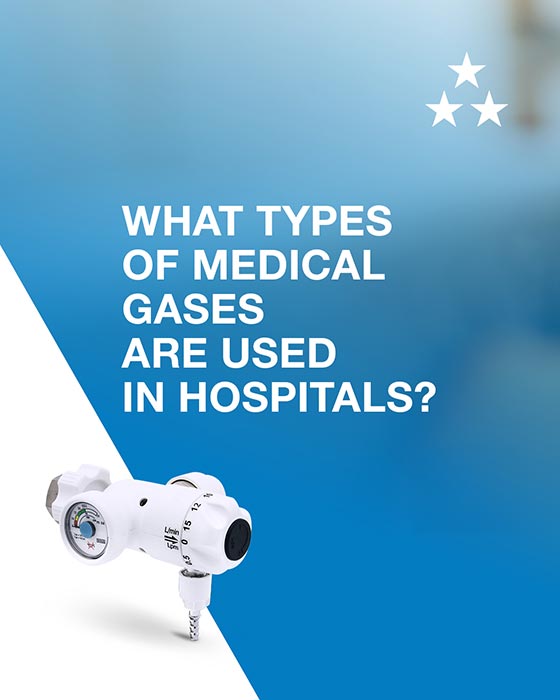
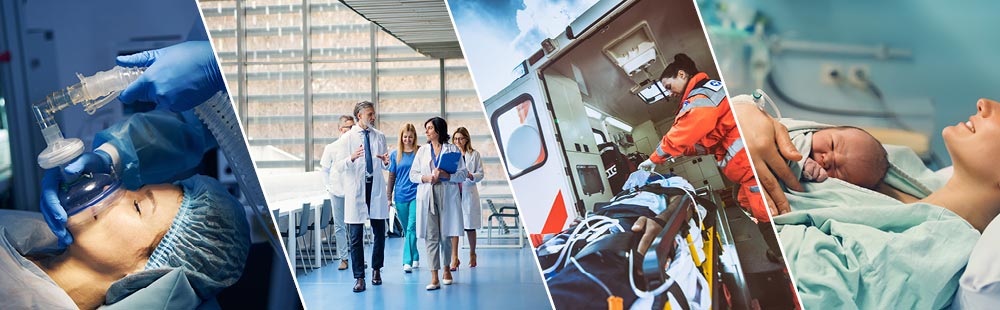
Medical gases are used throughout hospitals, from operating rooms and intensive care units to emergency departments and ambulances. While most gases are delivered through central pipeline systems, patients often need oxygen during transport between departments, and emergency teams operate without pipeline access. Certain gases, such as nitric oxide, cannot be distributed through pipelines at all. For these reasons, portable gas cylinders remain essential, requiring equipment that connects quickly, safely and reliably to the patient or the medical equipment, depending on the application.
Whatever the delivery method, each medical gas must reach the patient at the right pressure, flow and purity. This guide covers the main types of medical gases used in hospitals, how they are supplied in cylinders, and the medical gas equipment needed to control them safely.
What is the role of medical gases?
Medical gases are used in two main ways in patient care:
- Administered directly to the patient. Examples include oxygen, nitrous oxide and nitric oxide, which are inhaled for respiratory support, anesthesia, pain relief or other therapeutic effects.
- Used in treatment or procedures. Carbon dioxide, for example, is introduced into the body to inflate the abdominal cavity during laparoscopic surgery.
Gases may also be used in healthcare facilities to power medical equipment and pneumatic instruments. However, gases used solely to operate equipment are not necessarily classified as medicinal gases. Depending on the application, they may be considered technical or industrial gases and require dedicated equipment.
What are the applications of medical gases?
Medical gases administered to patients have a wide range of applications in modern healthcare. They are used in hospitals, clinics, emergency services and home care for respiratory support, anesthesia, pain management, surgery and specialist treatments.
From oxygen used in respiratory therapy to nitrous oxide used for anesthesia and pain relief, medicinal gases require safe, precise and reliable equipment to ensure effective delivery to the patient. Gases used solely to power medical equipment or instruments should be considered separately, as they are not necessarily classified as medicinal gases.
Medical Oxygen: Respiratory Support and Life Support
Oxygen is the most widely used medical gas and plays a central role in medical gas therapy. Oxygen therapy treats hypoxemia in patients with respiratory failure, pneumonia, COPD, heart failure or trauma. It is delivered by nasal cannula, mask, high-flow system or ventilator, and is essential in resuscitation, anesthesia, critical care and emergency transport. Because oxygen strongly supports combustion, all equipment in contact with it must be oxygen-compatible and free from oil and grease.
Many Rotarex Meditec VIPRs are designed for oxygen therapy. Examples include the M706 for hospital, home care and emergency use, and the compact RM200 Light for portable applications.
Medical Air: Ventilation, Gas Blending and Nebulisation
Medical air is clean, dry, oil-free compressed air with several important medical applications. Ventilators blend it with oxygen to deliver precise concentrations.It can also supply certain medical devices, including nebulizers, anesthesia machines and incubators. It is typically distributed at around 400 kPa (about 58 psi). For cylinder supply, Rotarex Meditec offers medical air pressure regulators and VIPRs configured for medical air.
Surgical Air: A Technical Gas for Pneumatic Surgical Tools
Surgical air is clean, compressed air supplied at a higher pressure, typically around 700 to 800 kPa. It is used to power drills, saws and other pneumatic instruments in orthopedic, neurological and dental surgery. Because it is used to operate equipment rather than being administered to the patient, it should be distinguished from inhaled medical air. Dedicated connections help prevent confusion between surgical air and breathing air.
Nitrous Oxide: Anesthesia and Pain Relief
Nitrous oxide, often called laughing gas, is used in anesthesia alongside oxygen and other agents. As a 50/50 premix with oxygen, it provides fast pain relief in childbirth, emergency care and dun jentistry. Its critical temperature is above room temperature, so it is stored as a liquid in the cylinder, and the pressure gauge does not show how much gas remains. Rotarex Meditec offers cylinder valves up to 300 bar and M706 VIPRs for N2O/O2 premixes.
Nitric Oxide: Specialist Inhalation Therapy
Inhaled nitric oxide (iNO) is a specialist form of medical gas therapy that dilates the blood vessels of the lungs. It is used mainly in neonatal intensive care to treat pulmonary hypertension of the newborn. It is administered at a few parts per million and requires very precise pressure control. Rotarex Meditec's dedicated nitric oxide range includes:
- the stainless steel D551 iNO VIPR
- DI235 regulators
- D413 cylinder valves
Read more in
Nitric Oxide (NO): A Life-Saving Therapeutic Gas.
Carbon Dioxide: Surgical Insufflation
During laparoscopic surgery, carbon dioxide is introduced into the abdominal cavity to create a working space for the surgeon. It is non-flammable and is readily absorbed by the body. CO₂ may also be used in cryotherapy.
Separately, carbon dioxide can be used in calibration mixtures for blood gas analyzers. In this case, it is used for a technical application rather than administered to the patient. Rotarex supplies C040/C045 valves and the C508 residual pressure valve for CO₂ cylinders.
Nitrogen: Technical Applications in Healthcare
Nitrogen is an inert gas used for several technical applications in healthcare environments. It can power pneumatic surgical tools in some hospitals. In liquid form, at −196°C, it is used for cryopreservation and for storing cells, tissues and other biological samples in laboratories and biobanks.
Because nitrogen is used here to operate equipment or preserve biological material rather than being administered to the patient, these applications should be distinguished from medicinal gas therapy.
Heliox: Easing Breathing in Airway Obstruction
Heliox is a mixture of helium and oxygen. It is less dense than air, so it flows more easily through narrowed airways and reduces the work of breathing in patients with airway obstruction or severe asthma. Rotarex Meditec VIPRs such as the M706 can be configured for helium/oxygen mixtures.
Other Specialist Medical Gases
Argon is used in specialist procedures such as argon plasma coagulation. Certain diagnostic applications, including lung function testing, use carefully prepared gas mixtures containing components such as carbon monoxide and helium. Calibration mixtures are also used to maintain the accuracy of medical analyzers.
The regulatory status of these gases and their associated equipment depends on their intended use. Gases administered to or introduced into the patient should be distinguished from gases used solely for calibration or other technical applications. For inert and specialty gas applications, Rotarex offers C200 series valves up to 300 bar.
Medical Gas Cylinders: Portable Supply for Hospitals and Beyond
Medical gas cylinders are filled at pressures of up to 200 or 300 bar (approximately 2,900 or 4,350 psi) and are widely used for patient transport, emergency care, bedside treatment, home healthcare, and for gases that cannot be distributed through a pipeline network. To ensure safe identification, each gas is marked with a dedicated label and color code according to ISO 32 standards.
The cylinder valve controls the high-pressure gas supply and provides an essential safety function at the cylinder outlet. When a standard cylinder valve is used, a suitable pressure regulator must be connected before the gas can be supplied at a usable pressure. For patient administration, the regulator or VIPR provides the pressure-control function required between the cylinder and the patient.
Rotarex Meditec offers a complete range of cylinder valves, including standard 200 and 300 bar valves, compact cone valves for portable cylinders, and gas-specific pin-index valves designed to prevent connection errors.
Many of these valves are also equipped with a residual pressure valve (RPV), which maintains a small positive pressure inside the cylinder after use. This helps prevent contaminants from entering during handling and storage, reducing the risk of internal corrosion and preserving gas purity between refilling operations.
What Are the Safety Standards for Medical Gases?
Safety and compliance are essential when storing, distributing and using medical gases in a hospital or other healthcare facility. Medical equipment and systems must meet strict international and national standards to protect patients, healthcare professionals and facilities.
The key standards are:
- ISO 7396-1 for pipeline systems
- ISO 10297 for cylinder valves
- ISO 10524-1 and ISO 10524-3 for regulators and VIPRs
- ISO 15001 for oxygen compatibility
- ISO 32 for cylinder color coding
In the European Union, products classified as medical devices must meet the applicable requirements of the EU Medical Device Regulation and bear the appropriate CE marking before being placed on the market. This requirement applies to products such as medical pressure regulators and VIPRs when they are placed on the market as medical devices. It should not be applied indiscriminately to every cylinder valve used with a medicinal gas.
Applicable Rotarex Meditec medical devices are designed to meet the relevant regulatory and technical requirements, including EU MDR and applicable EN ISO or CGA standards. Rotarex received its MDR certificate in January 2025.
Day-to-day safety practices are just as important as the equipment itself. Medical personnel should be properly trained in the handling and use of medical gases, and cylinders must always be secured to prevent falls that could damage the valve or turn the cylinder into a projectile. When working with oxygen, oil and grease must be strictly avoided, as they can create a serious fire hazard. Valves should be opened slowly to prevent pressure shocks that could damage equipment or compromise safety. Before any gas is administered, healthcare professionals should also verify the cylinder contents to ensure the correct gas is delivered to the patient.
What Equipment Do Medical Gases Require?
Medical gas cylinder equipment performs several essential functions. The cylinder valve safely opens and shuts off the high-pressure gas supply. A pressure regulator then reduces the cylinder pressure to a safe and usable outlet pressure. When gas is administered directly to a patient, a flow-control device can be used to select the prescribed flow rate. A pressure gauge or contents indicator provides information about the remaining cylinder contents.
These functions may be provided by separate components, such as a standard cylinder valve combined with a removable medical pressure regulator, or integrated into a VIPR. Equipment that delivers and controls the gas directly to the patient, such as the pressure regulator or VIPR, may be classified as a medical device according to its intended use.
When Should a Separate Valve and Regulator Be Used?
With this option, the cylinder carries a standard valve, and a removable regulator is connected each time the cylinder is used. It is the right choice:
- for manifolds and central supply systems
- when pressure or flow requirements vary
- for hospitals that already have a fleet of regulators
- for high-flow or specialist applications
Rotarex Meditec's M730 Alpinox regulators cover all medical gases. They come in several versions:
When Is a VIPR the Better Option?
A VIPR (valve with integrated pressure regulator, ISO 10524-3) combines the valve, regulator, flow selector and gauge in one unit that stays on the cylinder. It is often the better option:
- For emergency and transport use: the cylinder is ready immediately, with no regulator to connect.
- For safety: there is no high-pressure connection at the point of use, which means less risk of wrong assembly, leaks or adiabatic compression.
- For simpler maintenance: the gas supplier tests the VIPR at each filling.
- For stock visibility: the contents gauge is always readable.
A VIPR costs more per unit, but it removes the need to buy and maintain separate regulators. This often lowers the total cost of ownership.
The Rotarex Meditec VIPR range includes:
- M706: for 200 or 300 bar cylinders, with a 12-position flow selector up to 25 L/min and outlets to national standards (AFNOR, BS, DIN, DISS and others)
- RM200 Light: a compact model for home care and ambulances
- D551: for nitric oxide
A protective guard with an optional bed hanger and remote monitoring options complete the offer.
Key Features to Compare When Selecting a Medical Gas Regulator
- Compliance: ISO 10524-1 or 10524-3, and CE marking under EU MDR.
- Pressure and flow range: suited to the application, from low-flow oxygen therapy to device supply.
- Flow stability: constant flow as cylinder pressure falls.
- Gas-specific connections: outlets matching local standards and hospital equipment.
- Oxygen safety: oxygen-compatible materials and internal filtration, such as the 20 µm sintered bronze filter in the M706.
- Residual pressure valve: protects gas quality between fillings.
- Usability: a readable gauge, light weight, impact protection, easy cleaning and, for transport, π marking.
Conclusion
From oxygen therapy to laparoscopic surgery, medical gases are part of nearly every hospital care pathway, and the equipment that controls them is as critical as the gas itself. The choice between a separate valve and regulator or a VIPR depends on the application, the environment and the people who handle the cylinders.
Rotarex Meditec designs cylinder valves, pressure regulators and VIPRs for oxygen, medical air, nitrous oxide, heliox, nitric oxide and CO₂. Explore our medical gas equipment.